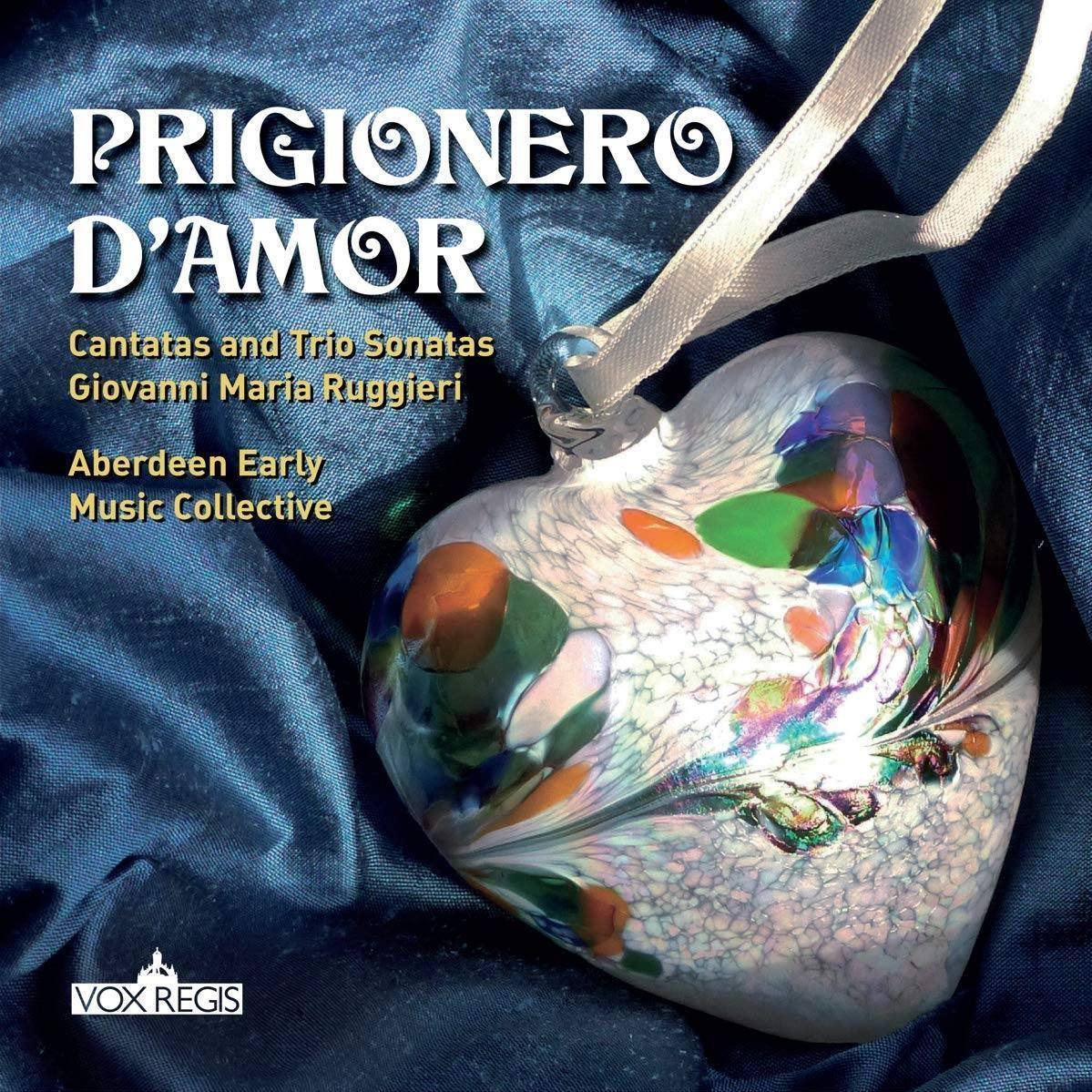
So THESE have become available on Amazon and other outlets…the first-ever recording of chamber works of Giovanni Maria Ruggieri! Our official launch event was held on Wednesday, 3rd October 2018, at 6:30 pm in the Old Senate Room at the University of Aberdeen. There were bubbles, some tasty things to eat, and just “a few words”. Jasmin Cameron entertained us with a few Details of Dodgy Dealings as perpetrated by the “prisoner” in question, but principally, we celebrated giving form to an interesting, unique voice that has been silent for over 300 years.
Author Archives
“…beautifully planned and brilliantly executed…”
I was very very pleased to read Roger B. Williams’s review of last November’s “Unidentified Edges” concert!
“The vocal part was something of a tour de force, using the full range of expression and register a singer can command. […] Both performers excelled today in a performance that had the audience wrapt in total concentration. […] Although this was by no means easy listening, the silence of the audience throughout suggested that they were actively engaged in this beautifully planned and brilliantly executed concert.”
The full review can be found on the website of the Aberdeen Art Gallery and Museums concert series. Scroll down to November and click on the link below the concert listing.
“Unidentified Edges”: Geoff Palmer
Thursday, 2 November, at 12:45pm, at the Salvation Army Citadel, Aberdeen
Sound Festival in collaboration with Aberdeen Art Gallery Lunchbreaks
A programme that is very special to me: Geoff Palmer’s new song cycle, “Unidentified Edges”, on poems by Anne Cluysenaar (for voice and cello, played by Claire Babington). Her texts evoke the ancient ideas of the Universal Music, using modern imagery from physics and astronomy, such as the Higgs boson and the Kepler space telescope. We pair them with a collection of John Dowland, including some of his most philosophical lute songs. To finish with “…into the world of light”, by Geoff on a text of 17th-century metaphysical poet Henry Vaughan, composed as an elegy to Anne Cluysenaar.
“La Naissance de la Musette”: Aberdeen Early Music Collective
Apparently, Bonnie Prince Charlie’s favourite instrument was the Musette, a gentle-sounding baroque bagpipe. As far as we can tell, however, our concert on Thursday, 28 September was the Musette’s first appearance in Aberdeen, in the hands (and under the arm) of Amanda Babington. The programme featured Michel Corrette’s cantata, “La Naissance de la Musette”, as well as Sonatas for musette (Senaillé), violin (Rebel), and cello (Boismortier), and finishing with a favourite cantata, “Pan et Sirinx” (Montéclair). Last time, we did this cantata with a (small) host of winds and strings and big bass; this time, just violin and continuo, but still an awesome cantata, despite the slightly disturbing message of the final aria!
“Frenemies”: Aberdeen Early Music Collective
On Thursday, 29 September, 7:30 pm, King’s College Chapel, the Aberdeen Early Music Collective kick off our 2016/17 activities with a new programme, based around composers who tangled with Händel in some fashion, whether with words, in business dealings, in musical battles, or with actual swords! There’s chamber music for varied combinations of recorders, violins, cello, and continuo, and some solo keyboard music, selected from Telemann, Marpurg, Mattheson, Porpora, and Scarlatti (Domenico, natch). And of course, just a bit of (attributed to) Händel to finish: the Gloria for soprano, 2 violins, and continuo.
“Der kleine Tod” first performance…
…received a very nice review from Alan Cooper:
“Today’s song duo gave us a marvellous account of all the songs. Frauke’s performance was wonderfully clean and clear with perfect German and a dynamic vocal range that went from the gentlest whispers to wonderfully passionate crescendos with pure clear firmly held top notes. […] The wide vocal leaps in the Strauss songs, one of this composer’s stylistic signatures, were beautifully smoothly and naturally sung […]. Ralph’s playing here was emblematic of his performances in all of the songs. In Wagner’s Im Treibhaus […] the original piano score came through more expressively than in any of the orchestral versions I have heard.”
Der kleine Tod: Friday, 16 September, 4pm, King’s College Chapel, Aberdeen
With Ralph Stelzenmüller on piano, I’ll be performing an unusual juxtaposition of three cycles of Lieder: Alban Berg’s Op. 2, Richard Strauss’s Op. 27, and Wagner’s Wesendonck-Lieder. In that order! The texts and tonal language melt from one group of songs to the next, intertwining metaphors of sleep, death, love, and sexuality.
A stiff malt may be warranted afterwards.
Busy week recording Ruggieri
Seagulls! Despite the intrusive exclamations of the Aberdonian Mega-Gulls resident atop the towers of King’s College (I think they were teaching the fledglings to fly, and it was all terribly exciting), the Aberdeen Early Music Collective, and dearly beloved guests, managed to finish only a few hours behind schedule…Watch this space! On the menu was a representative collection of soprano and alto cantatas and trio sonatas from this contemporary of Vivaldi. Aberdeen musicologist Jasmin Cameron’s research has unearthed many interesting details of his somewhat dodgy life (he died in prison), and has made his works available for performance in modern editions.
Second instalment of Chez Schedel
We performed our second programme in the Chez Schedel project on Thursday 3 December (in King’s College Chapel, Aberdeen) and Saturday, 5 December (in Woodend Barn, Banchory), welcoming Marc Lewon (voice and lute) and Uri Smilansky (viola d’arco), along with Caroline Ritchie (viola d’arco) and Ralph Stelzenmüller (organ/harpsichord). The programme had a bit of a Christmas theme, and some audience participation: some digging in online hymn databases revealed a 19th-century English translation of Der Tag der ist so freudenreich, so we performed alternatim verses in German monophony, Latin polyphony, and instrumental settings, while the audience sang “Royal day that chasest gloom”. Marc’s beautifully-rendered Tenorlieder, especially athmospheric in the candle-lit warmth of Woodend Barn, helped expand the programme’s German content, while we continued to explore the renditions of French, English, and Italian repertoire in German manuscripts. One of my favourites is a Latin contrafact of Mille bonjours from the St-Emmeram Codex.
“Chez Schedel” project première!
Saturday, 30 May and Sunday, 31 May (University of Aberdeen May Festival) saw the first performances of the Aberdeen Early Music Collective’s new project Chez Schedel, in which we reconstruct a musical entertainment as it might have been performed in Nuremberg in the 1460s. Many modern performers and audiences are still insidiously influenced by the desire to determine a composer’s intention or authority, even for musics where such a notion may be problematic. We depart from this by collecting pieces from a wide geographical and temporal origin, and trying to crystallise what these pieces might have sounded like, in one place and time. For our first performances, regulars Frauke, Ralph Stelzenmüller (organ) and Caroline Ritchie (viola d’arco) welcomed esteemed guest Uri Smilansky (viola d’arco). The programme included a mix of German songs (performed with texted superius), Latin contrafacta of songs of diverse origin (including some of Frye and Du Fay’s biggest hits), keyboard intabulations, and a few chansons with their original French texts. On Sunday, we added a basse danse, and Uri and Caroline improvised while I taught the basic steps to an enthusiastic little girl from our audience! Stay tuned for the next installment in December, when Marc Lewon will join the lineup, and we will explore some more homegrown, German genres! Wine is no use until you’ve had at least three drinks (claims the Buxheim Organ Book), so find out what happens after drinks four through ten!
